
MUTINY.
A one-time story. A takeover. An origin.

Editor’s note: This is the origin story behind Captain of This Ship. Most posts here are more direct, less cinematic, and closer in tone to Welcome Aboard.
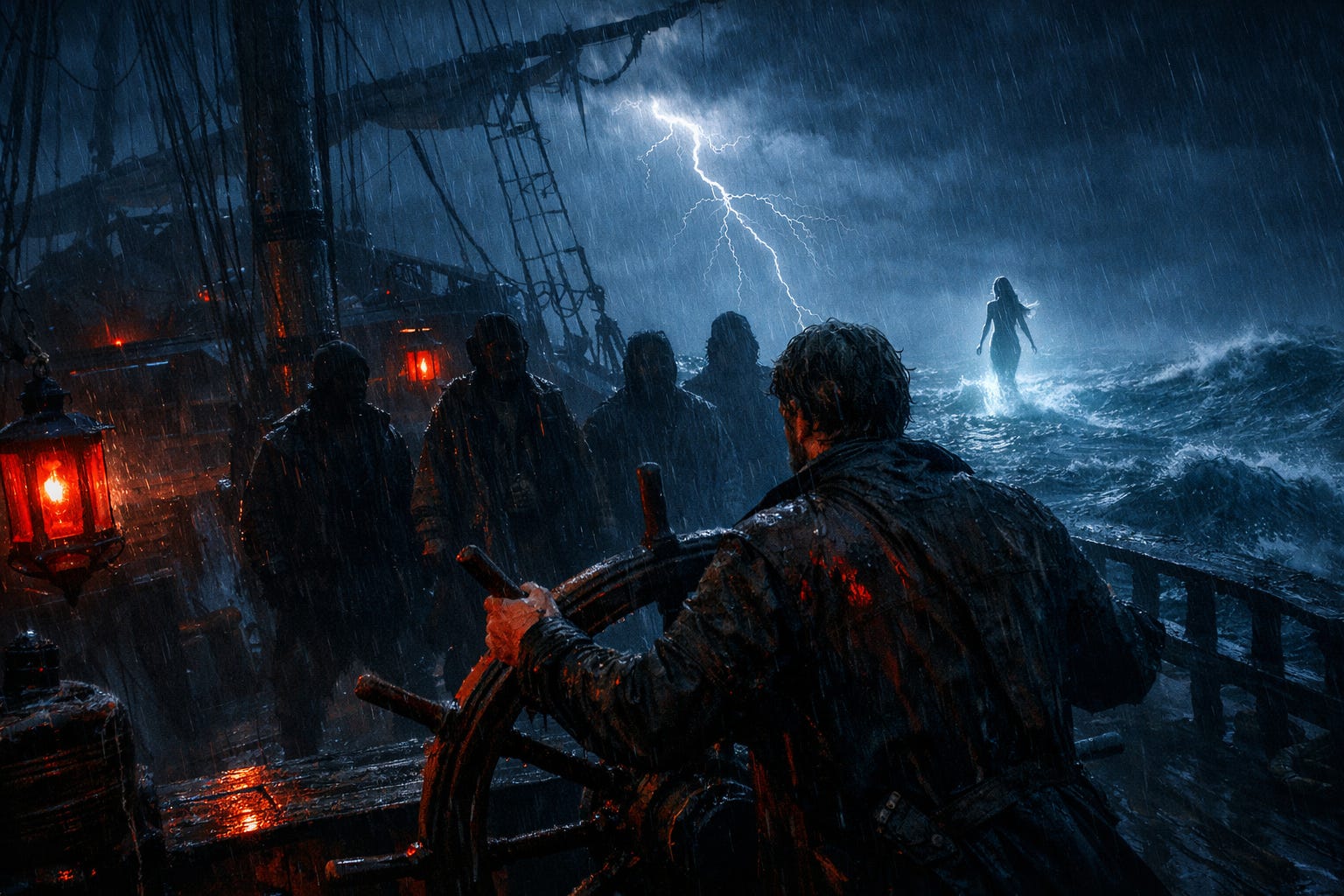
I woke up choking on saltwater that wasn’t there.
Eyes open. Dark cabin. Old spirits living in the seams. The lantern on the wall pulsed like a weak heartbeat. The ship pitched hard enough that the desk drawer slammed itself open, then shut, like it was trying to bite.
Twenty minutes. Maybe less. That was all the sleep I’d stolen before the nightmare hauled me back.
In the dream, the sirens had found me again.
They always find me.
They weren’t women, not really. Not bodies. Not lips. They were a promise with a voice. Relief with a melody. The kind of singing that makes you believe you’ve been wronged by temperance.
They stood on rocks shaped like empty bottles, hair whipping in the storm. They sang my name like a pardon.
And I went. Of course I went. That’s what I do. That’s what I’ve always done. Someone offers me relief and I don’t ask what it costs until the bill shows up in my teeth.
I stepped off the deck as if the sea had suddenly become a bed. My boots broke the surface. The water turned black and heavy, thick like oil. Something pale moved beneath me — a white shape without features. It rose like a moon under the waves.
Then the sirens leaned close and sang the line they always save for last:
Now you pay.
The Locker opened like a mouth.
And I woke up.
Cold sweat. Shirt glued to my ribs. Heart hammering so hard I could feel it in my teeth. Palpitations — each one a gunshot in a quiet room. My hands were already trembling.
The dream had nothing to do with that.
I sat up too fast and the cabin tilted sideways. Vision stuttered. Lantern light smeared. Skin crawling. Nerves lit. Something under the bone refusing to stay still.
Then I saw “her.”
Something wearing the shape of a woman in tattered robes hanging in the corner of the cabin, floating in zero gravity, grey hair over her face. Then her head twitched and she looked at me with eyes like black sinkholes, and I jumped so hard it felt like my heart misfired.
I’d been hearing music all night. Seeing things that weren’t there. I didn’t think it was a demon. I knew I was losing my mind.
That was the moment the night stopped being survivable and became medical. Not “ride it out.” Not “rough night.” ER. Now. Before this turned into DTs.
Hallucinations. Withdrawal. Not a ghost story. The body telling the truth the mouth refused to.
This had happened before.
Not the dream. The shaking. The hallucinations. The crawling skin. The way reality would come loose at the edges. It had happened before, but I’d always managed to chemically redact the part where my body was trying to tell me I was in deep. Then I’d wake up and call it a hangover, not withdrawal, because hangover is a word that normal people use and withdrawal is a word that people like me use, and I was not ready to be people like me.
That was the trick every other time. I never let the body finish the sentence. I drowned the evidence, passed out, woke up, and renamed the wreckage.
This time I couldn’t do that. By the time the music was in the walls and a robed woman was floating in the corner of my room looking at me with eyes like black depths of nothing, we were past “bad night” territory. Then came the first days without a drink — not noble, not cinematic, just stripped of the usual escape hatch.
That’s what this story is about. Not the night I got sober. The night I stayed awake long enough to hear what was actually happening inside me.
Anyway.
From somewhere impossible, I heard music. Soft at first. A thread. Then clearer. A melody that felt like an old argument I’d already lost.
My stomach rolled.
The ship groaned.
And the storm — the storm was the worst it had ever been.
Which is saying something, because I had lived in bad weather so long it started feeling like home. But this one was different. This one wasn’t weather. This one was judgment. The kind of storm that doesn’t want to test you. It wants to collect.
Outside the porthole: black water, white foam, lightning that turned the world into a photograph every few seconds. Wind screaming like it wanted in. The ship leaned so hard I thought we’d roll and never come back.
Feet to the floor. Boards cold. The ship pitched again. I caught myself on the dresser.
On the desk sat the map — an old chart stained by years of spilled spirits and shaky hands. Ink bled. Edges curled and brittle. It had carried me through a thousand “fresh starts.” A thousand “this time I mean it.”
A fresh wave hit the hull. The ship shuddered.
Taking on water.
I knew where we were. These waters had names. I’d sailed them so often I could find them blind.
Not far ahead was a harbor. A crude inlet carved into the coastline, hidden from honest maps. The kind of place you only learn about from men who don’t want to be found. A place where storms didn’t matter because the docks didn’t ask questions. Where you could “restock” and call it “maintenance.” A place to disappear for a night and come back with a new lie.
I felt it in my chest like hunger.
I wanted to go. Not in some tortured, cinematic, “the darkness called to me” way. In a practical way. In a “this makes sense right now” way. I could find any excuse. I had a hundred versions of this speech and every single one of them sounded reasonable. And every single one of them ended at the same dock.
Just a quick stop.
Just for safety.
Just long enough to stop the shivering. Steady the ship.
I could do what I’d always done: steer straight into the Bottle and call it survival.
The map of a man who keeps circling the same waters and calls it navigation. I know that man. I am that man. Or I was. That’s still the argument. The tense changed that night. Five hundred days later, I still don’t fully trust the past tense.
Boots on. Out of the cabin. Up the narrow stairs. Toward the deck.
The ship bucked under me like it was throwing a rider it didn’t recognize.
I reached the helm. The wheel was slick with rain and salt. Wind slapped my face hard enough to sting. Storm roaring.
And for a second — I felt alive. That manic clarity storms give you. That dangerous energy that says: You’re built for this. You’re the captain.
I knew that voice. It had gotten me through rooms, crises, deadlines, bad decisions, and just enough disasters to make me trust it longer than I should have.
It’s the voice that sounds like confidence and functions like a noose.
I wrapped both hands around the wheel.
And I turned it. Sharp. Too sharp.
The rudder bit hard. The bow swung toward darker water — toward the harbor, toward the old arrangement.
The storm fought back immediately. A gust slammed into the sails, ship heeled hard, deck tilting under my boots. Rigging snapped and screamed. A wave crashed over the bow and came at me like a wall.
I braced.
And then I heard it.
Footsteps.
Not one pair. Many. Heavy boots on wet deck.
The crew was coming.
Of course they were.
Withdrawal wakes everything at once. The parts of you that usually take turns start crowding the deck together, loud, wet, and done waiting for permission to speak.
I kept my hands on the wheel.
Brick, the boatswain, cleared the mast first — soaked through, broad as a bulkhead, knuckles cracking once like a verdict.
Behind him came Count, the quartermaster — ledger wrapped in oilcloth against his ribs like scripture. He didn’t look at the storm. He looked at me — already calculating the exact weight of the lie I was telling myself.
Then the rest spilled out behind them.
Patch was already down on one knee, hands searching the seams for the leak my pride had ignored. Glass stood at the rail, scanning the horizon and then me. Rust came up behind him with his sleeves rolled and his jaw set, looking like a man watching a machine get run into the dirt by someone who swore he had it handled.
The chaplain and the joker flanked the companionway — Creed and Shiv. Prayer and punchline, sincerity and sneer, both looking at me with the same exhausted patience.
And then Shakes.
He didn’t arrive so much as vibrate into place. Breath too fast. Hands twitching like they were wired to a live current.
They crowded the helm. I could feel the heat of them against the cold rain.
I laughed. Too quick. Too thin.
“What is this.”
Count tapped the ledger. “You changed course.”
Brick stepped closer. “We felt it.”
“Storm’s pushing us,” I said, too fast.
Glass looked past me toward the dark slit in the coastline. “Storm doesn’t push you that way.”
Shiv let out a soft whistle. “Ah. The maintenance dock.”
Patch didn’t look up. “We’re taking water and you’re steering into it.”
Rust wiped salt from his mouth. “He always does.”
Creed said nothing. He just looked at me like he could already see the confession trying to climb its way out.
Shakes was still trembling. Voice barely holding together.
“Captain...”
I tightened my grip on the wheel until the wood groaned.
Nobody moved.
But the deck had changed.
It was no longer just me and the storm.
Then Shakes finally got the words out.
“Captain, you’re sick.”
I snapped my head toward him. “I’m fine.”
It was the lie I was most fluent in. I wasn’t fine. I’d known that for ten-thousand miles. “I’m fine” was my own national anthem — sung while the ship goes vertical. It’s the reflex of a man who would rather have his pride than his pulse.
Count cut through the music. He lifted the ledger a fraction, keeping it dry. “You haven’t eaten,” he said. “Not in days.”
Patch shoved past me and darted down the companionway. A second later the cabin door banged open under the deck.
The room told on me immediately.
A week of untouched dinners sat there, the food turning to stone in the dark — a monument to the point where the drink had started mattering more than the blood.
When Patch came back up, he didn’t look angry. He looked like a man watching a keel snap in real time. Practical men understand what prideful men refuse: you can’t sail a ship on a hollow gut and a lie. He saw the plates, saw the state of me, and I could feel him making the terrible transition from repair to triage.
That’s one of the uglier tricks at the end: the drink hits harder on an empty stomach. You starve the body to drown the man. Not a cry for help. Engineering.
Suddenly Brick stepped in close enough that I could smell salt and iron on him. Jaw set.
“This is a mutiny.”
My hands locked on the wood. Instinct kicked in — the old reflex, already looking for a way out. Usually this is where I’d drown them. Pour enough to silence the deck. Knock the crew unconscious with numbness and call it peace.
That was the system. The Bottle wasn’t just a harbor. It was how I fought mutiny. I used poison to silence the parts of me trying to save my life. If Shakes trembled, I drank until he stopped moving. If Count opened the ledger, I drank until the ink bled. I drank until even the silence of God felt like peace to Creed.
Not this time.
This time there was no bottle between me and what was happening. No anesthesia. No escape hatch. Just every lie I’d told myself coming due at the same time.
I turned toward the storm to hide the quiver in my jaw.
And that’s when I saw her.
Not on the water. In the storm. A shape in the lightning.
My favorite lie.
She raised a hand like she was offering it to me.
The music returned — sweet enough to make my bones ache. My shoulders dropped. My mind started sliding toward that soft, deadly sleep that feels like coming home.
Sirens never say destroy yourself. They say just tonight. They say you deserve rest.
Rumbling beneath the song, I heard the actual price.
Not a song.
A transaction.
He’s mine. Collect the debt.
Lightning cracked. For a split second her smile looked wrong. Too wide. Too hungry.
Her eyes weren’t eyes.
They were places things disappeared.
Brick’s hand clamped onto my shoulder.
“Captain.”
His grip hurt.
Good.
Pain meant real.
Rust stepped between me and the horizon like a man facing a firing line. Glass cut the song in half.
“DON’T LOOK!”
Shiv gave a sick little laugh.
“Careful, Captain. You’re flirting with mouthwash in a dress.”
Creed’s voice came low and steady.
“Hold on.”
And the spell snapped.
I tore in air like I’d been underwater too long. My hands were slipping on the wheel. My knees went hollow. For a second I couldn’t tell whether I was steering the ship or just standing there while something worse took over.
The deck lurched hard beneath us. Water came over the bow and tore across the planks around our boots.
The ship groaned like something alive and in pain.
Then Shakes stepped forward and said the thing none of the others could say.
“This has happened before.”
Nobody spoke.
He was still trembling. Still forcing the words through a body in revolt.
“The shaking. The crawling skin. The music. The things you see in the dark. This has happened before. More than once. And every time you drowned me before I could finish. You poured until I went quiet. Then you woke up, called it a hangover, and pretended nothing was wrong.”
My jaw locked.
“This is what it actually is,” he said. “This is what it’s been. Every time. You never let the body finish the sentence, because if you did, you’d know. You’d know how bad it is. You’d know how long it’s been. You’d know the shaking isn’t the problem. The shaking is the body trying to survive you.”
And then the thought came in cold and clear.
If you keep the helm, you die.
Not someday. Not metaphorically.
Soon.
Brick leaned in through the rain.
“You don’t get to romanticize this.”
Count lifted the ledger.
“And you don’t get to rewrite it.”
Patch flicked a finger toward the deck.
“Hull’s taking water.”
Rust spat rain from his mouth.
“WORK.”
Creed muttered, “I’ll pray and work.”
Shiv snorted. “Consecrate it after we stop drowning.”
Glass kept scanning the dark.
“Sirens are close.”
The storm roared.
The song tried to rise again.
And then the crew moved. Not as a debate. As a response.
Brick seized the wheel with me — one hand locking over mine, the other clamping down on my wrist like he was pinning down a weapon.
“Hands off.”
Not loud.
Final.
“You’re relieved.”
Something in me cracked.
Not pride. Something older than that.
A loneliness.
The belief that I had to hold the helm alone. That if this ship survived, it had to be because I dragged it there myself. That if I let go, even for a second, everything would come apart and it would be my fault.
So when my fingers started to loosen, it did not feel like rescue.
It felt like grief.
My hand came off the wheel.
The ship did not sink for it.
The wheel stayed steady under Brick’s grip.
Count pointed.
“Flare.”
Rust looked at Shakes.
“Run.”
Shakes ran.
Slipped once. Caught himself. Kept going. And I watched him — the part of me I had ignored the longest, silenced the hardest, punished the most — running across a pitching deck in the dark trying to save the ship anyway.
Glass leaned into the rain.
“Light! There.”
A lighthouse beam cut through the storm for half a second. A pale sweep across the void.
It reached through the storm without asking whether I deserved it.
Creed’s lips moved.
Shiv leaned toward him. “If He answers, tell Him we’re late.”
Patch dropped to his knees by the hatch, tore up a plank, and found the leak almost immediately.
Of course he did.
“Here,” he barked. “This is where we’re failing.”
He jammed cloth and tar into the breach with both hands, brutal and precise.
Rust was already at the anchor chain, pry bar wedged into the seized mechanism, shoulders straining.
“Come on.” He growled at the metal. “MOVE.”
The chain shrieked. Then shifted.
Count ducked below and came back with the old chart. Rain slapped it immediately. Ink bled. Lines vanished. He looked at it once, and tore it clean in half.
No speech. No ceremony.
He touched it to the lantern.
It went up fast.
The rain tried to kill the flame.
Didn’t.
He let the old map burn down to black curl and ash, then pulled dry paper from inside his coat and started drawing new lines.
Not a vow.
A direction.
Shakes came back with the flare gun, hands jumping so badly he almost lost it. Brick took it from him. Steady. Fired.
The flare lit up the deck and rocketed into the night — red light blooming over black water.
For one brief second the whole ship stood exposed. The mast. The rigging. The torn sail. Frightened men. The full wreck of us.
The song faltered.
Glass shouted, “THEY SAW IT.”
The lighthouse beam passed again — brighter now, sweeping through the rain like an answer.
Brick forced the helm toward it.
“Course set.”
Shiv cupped his hands to the storm. “TOO LATE, sweetheart. He’s being supervised.”
And against all reason, something in me almost laughed.
Patch kept sealing the leak.
Rust kept working the chain.
Count kept drawing.
Glass kept scanning.
Creed kept praying.
Shiv kept sneering.
Shakes kept moving.
Brick kept the ship from answering me.
I stood there soaked and spent, hands empty.
The storm still raged. The ship still groaned. The sea still wanted us dead.
I swallowed hard.
“Okay. I was trying to take us to the harbor.”
I waited for the shift in the air. Applause for my honesty. But no one rushed in to comfort me. No one acted shocked.
Count gave one small nod, like he was hearing a number confirmed.
Patch kept working the leak. “Yeah,” he said. “We know.”
Brick never looked back.
“Then hear me clearly. You don’t get the helm back tonight.”
The ship lurched hard. Somewhere out in the dark, the song tried to find me again.
Glass snapped, immediate.
“DON’T LOOK.”
I didn’t.
I fixed my eyes on the lighthouse beam until they watered.
The deck pitched. The chain rattled. The leak slowed.
The boatswain held the wheel.
The flare was gone.
The lighthouse wasn’t.